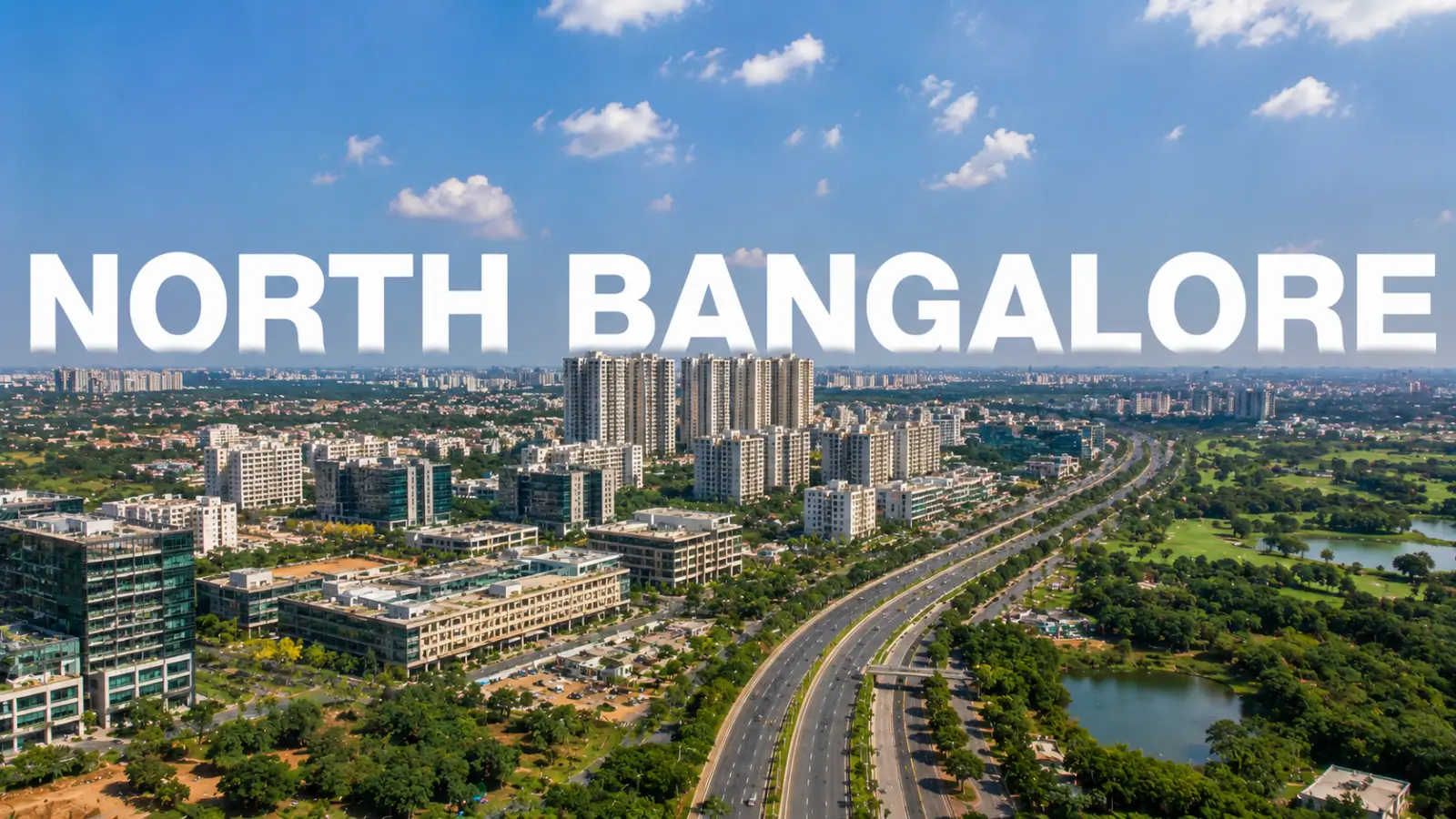
North Bengaluru's next decade of growth is supported by airport expansion, metro construction, employment hubs and limited land supply, strengthening long-term real estate demand.
North Bangalore growth next decade forecasts are worth reading with a specific question in mind: which parts of this are committed and which are hoped for? The last decade in this corridor delivered genuinely - villa rates ran from roughly Rs 4,200 a sft in 2019 to about Rs 12,000. What follows starts from a materially higher base, and that changes the arithmetic more than most forecasts admit.
What Is Committed
Three things you can plan around. Terminal 2 has already widened airport capacity - delivered rather than promised. Namma Metro's Blue Line to the airport is under construction through this corridor with the Doddajala stop on the alignment. The Satellite Town Ring Road progresses across Doddaballapur, Devanahalli and Hoskote. Each is civil engineering in progress rather than a concept on a hoarding.
What Is Building
Employment, which is the variable that actually sustains everything else. The KIADB Aerospace Park and Devanahalli SEZ at 20-22 km from Bettahalasuru continue drawing aerospace, logistics and supporting industry. Devanahalli Business Park sits at about 17 km. Manyata Business Park anchors the corridor's southern end at roughly 19 km. Global capability centres keep moving north because their leadership flies weekly.
What Is Speculative
Everything else, and it should be priced at zero. Township launches marketed on infrastructure that has not started. Road widenings announced without allocated funding. Healthcare facilities discussed but not commenced - which matters here, because hospitals sit 15-17 km away and nothing under construction changes that. North Bangalore future real estate commentary routinely blends these categories, and buyers pay for the blend.
The Yelahanka Devanahalli Forecast, Carefully
The two belts will diverge rather than move together, and a single corridor forecast obscures that. Devanahalli carries township-scale land still arriving, which means choice, competitive pricing and a lower entry point - it ran from about Rs 5,500 a sft in 2020 to Rs 11,000-13,000 in 2026. Yelahanka and its belt are closer to built out with a settled social base, and led the zone at roughly 21.5% year on year in 2026. Expect the first to offer the earlier entry and the second the lower variance.
The Base Effect
Here is the number nobody wants to run. A trebling from Rs 4,200 a sft is one thing; the same multiple from Rs 12,000 would put the belt near Rs 36,000 a sft by 2036, which would make it among the most expensive residential land in the country. That may happen. Planning on it is not analysis. Wider Bengaluru is forecast at roughly 10-12% growth in 2026, and a decade at that rate roughly doubles values - which is a serious return without requiring fantasy.
What Would Genuinely Change the Belt
Two things, neither guaranteed. Metro services actually running rather than being built would compress the airport and city commute and trigger the second repricing that rail usually delivers. A major hospital inside ten kilometres would remove the corridor's sharpest structural weakness. Watch for those rather than for retail announcements or township launches, which move the number far less than either would.
The Supply Constraint
This is the most durable part of the case and the least discussed. Large low-density parcels inside the airport belt are effectively gone - assembling 30 acres eight kilometres from an established school belt is no longer possible at any sensible price. Future launches here will be smaller, denser or further out. That constraint applies to every developer equally and does not ease with time, which is the one variable a downturn cannot reverse.
How to Hold a Ten-Year View
Buy on what works today - road access, school catchment at 1.5 to 7 km, the airport at roughly 17 km - and treat the pipeline as upside you did not pay for. Model the return at 8% rather than 20% and check the purchase still holds. Then stop reading forecasts, including this one, and read the quarterly RERA filings instead. Those describe what is happening rather than what somebody hopes will.
Forecasting Honestly
Any north Bangalore growth next decade projection should carry its assumptions on the surface. Ours are simple and stated: the airport stays and grows, the metro eventually runs, employment at the aerospace belt and Devanahalli Business Park continues building, and large low-density land inside the belt does not reappear. Change any one and the picture shifts. Remove the last one and it collapses - but land does not un-develop, so that assumption is the safest of the four.
Which is why the supply argument carries more weight than the growth-rate argument. Rates are a forecast; the absence of 30-acre parcels is a fact. Buyers who anchor on the second sleep better than those who anchor on the first, and their case survives a downturn that the percentage-chasers' does not.
What a Decade Actually Looks Like
Unevenly, is the honest answer. Corridors do not compound smoothly - they move in steps around events, then flatten. Expect a step when metro services begin, another if a major hospital lands inside ten kilometres, and long quiet stretches between. Households buying to live capture the use value through the flat periods. Investors watching a chart through the same years usually sell during one of them.
Related Articles

Bangalore, GCC Capital: What It Means for Property Investors
Bangalore's GCC expansion is boosting North Bengaluru through leadership hiring, airport connectivity and sustained housing demand, making Bettahalasuru attractive for long-term villa investment.

Bangalore Smart City Initiatives & Their Real Estate Impact
Bangalore's smart city impact is driven by completed infrastructure, not announcements. North Bengaluru benefits from the airport, metro construction and road connectivity.
The Airport Economy: How KIA Is Reshaping North Bangalore
Bangalore Airport is driving North Bengaluru's growth through jobs, infrastructure and housing demand. Bettahalasuru benefits from this expanding airport economy, making it a strategic residential location.

How Bangalore's IT Boom Keeps Driving Real Estate Demand
Bangalore's IT boom continues to shape North Bengaluru through employment, airport-led growth and diversified industries, strengthening long-term housing demand around Bettahalasuru.