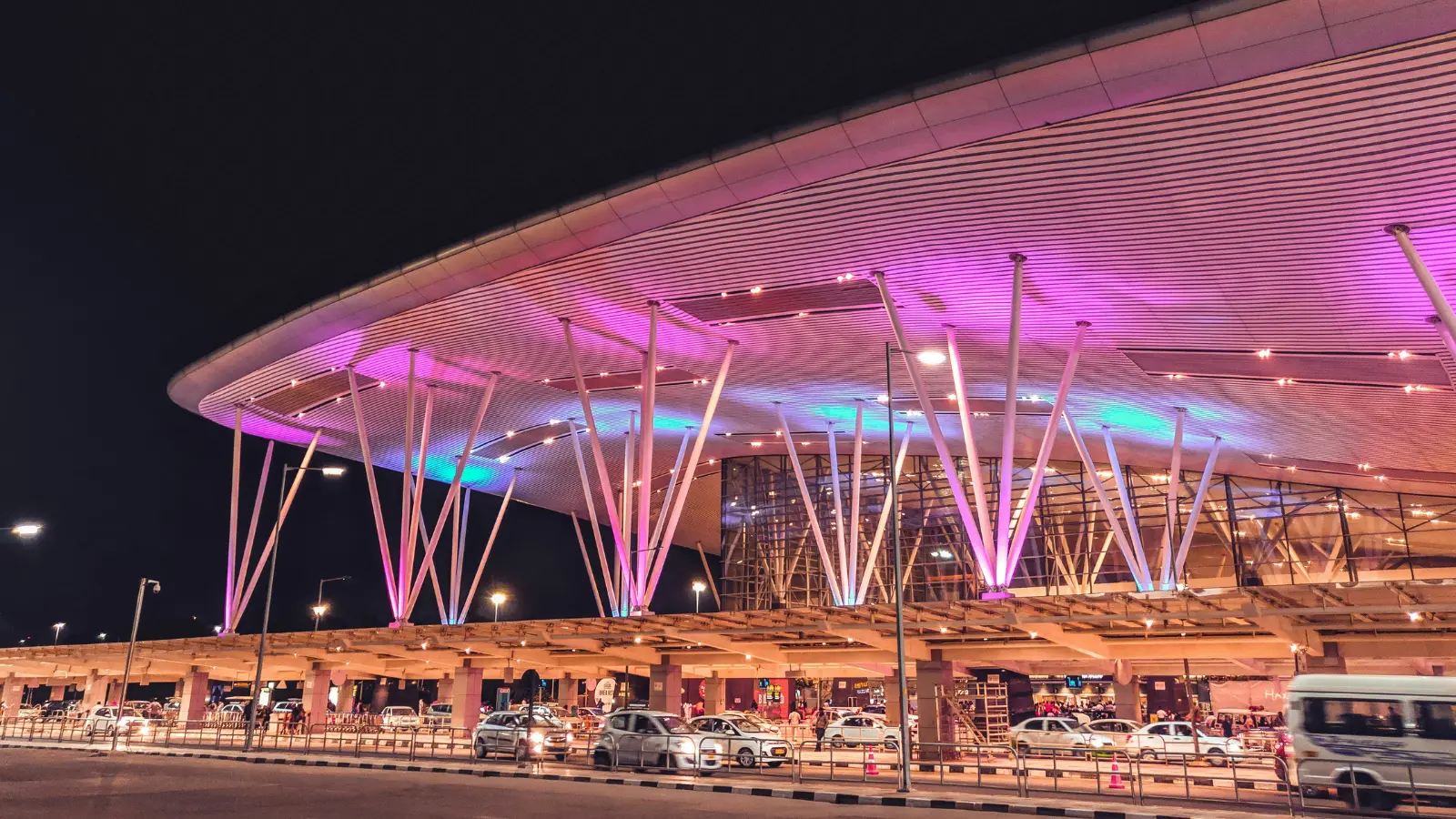
Bangalore Airport is driving North Bengaluru's growth through jobs, infrastructure and housing demand. Bettahalasuru benefits from this expanding airport economy, making it a strategic residential location.
Bangalore airport economy real estate effects are usually described backwards. People assume an airport raises nearby land values because proximity is convenient. What actually happens is slower and larger: an airport creates an economy, that economy creates employment, and employment creates housing demand. Convenience is a rounding error by comparison.
The Sequence
It runs in a predictable order and it has run here. A terminal lands 30 km from the centre. Roads follow, because they must - Bellary Road grade-separated for much of its length carrying traffic north on the NH-44 corridor. Land between the city and the terminal fills in phases: highway frontage first, then arterial roads, then the interior. Bettahalasuru sits in that third phase, which is why it repriced later and faster.
Kempegowda Airport Growth Impact So Far
Terminal 2 widened capacity, and that is the change most people forget to count because it has already happened rather than being promised. More capacity means more traffic, more employment around the airport zone, and more pressure on the corridor's road and rail. Infrastructure that has landed is worth more in a valuation than infrastructure that might, and the terminal is this corridor's anchor asset.
What an Airport Economy Contains
Far more than the terminal. Aviation services, ground handling, cargo and logistics. The KIADB Aerospace Park and Devanahalli SEZ at 20-22 km from Bettahalasuru, drawing aerospace manufacturing and supporting industry. Devanahalli Business Park at about 17 km. Hotels, conferencing and the business travel apparatus. Global capability centres whose leadership flies monthly. Each layer employs people, and people need houses.
The Land Response
Prices tell it plainly. Villa rates across the airport belt moved from roughly Rs 4,200 a sft in 2019 to about Rs 12,000 now. Devanahalli ran from around Rs 5,500 a sft in 2020 to Rs 11,000-13,000 in 2026, compounding near 13.5%. Yelahanka led North Bengaluru on year-on-year appreciation in 2026 at roughly 21.5%. Jakkur sits near Rs 9,000 and Bagalur, further out, nearer Rs 4,000 - dispersion that shows where the effect concentrates.
Airport City North Bangalore Is Becoming
The pattern is familiar from other cities: an airport creates a second centre rather than a suburb. Employment, retail, hospitality and housing cluster around it until it stops depending on the original core. Bengaluru's north is somewhere mid-way through that transition. Namma Metro's Blue Line to the airport is under construction, the Satellite Town Ring Road connects Doddaballapur, Devanahalli and Hoskote, and households increasingly work north rather than commuting south.
Where Residential Fits
Not adjacent. Land immediately around an airport is worth more as commercial, logistics or hospitality, and it suffers residentially from noise and freight. The residential sweet spot sits at the edge of the commute band - close enough to capture demand, far enough to stay quiet. Bettahalasuru at roughly 17 km from the terminals occupies exactly that position, which is not an accident of marketing but of land economics.
The Height Consequence
One airport effect buyers rarely consider. The Airports Authority of India issued NOC BIAL/SOUTH/B/071224/1114884 on 9 August 2024, valid to 8 August 2032, capping permissible top height at 974.8 m above mean sea level against a site level of 924.8 m. Which is why nothing here goes taller than ground plus two floors at 11.725 m. Airport proximity structurally enforces low-rise development, and low-rise plus scarce land is what produces villa communities.
The Honest Limits
Airports do not deliver hospitals, and this belt has none closer than 15-17 km. They do not create walkable retail. And a corridor built on an airport carries concentration risk in the same way a technology corridor does - aviation is cyclical too. Land values in this corridor are projected to keep rising as the infrastructure pipeline completes, but projection and outcome remain different things.
How Airport Corridors Mature
The pattern repeats internationally and it has three phases. First, land near the terminal trades on speculation and little gets built. Second, employment arrives and housing follows at the edge of the commute band. Third, the corridor develops its own centre and stops depending on the original city core. Bangalore airport economy real estate sits somewhere in the second phase moving into the third.
Which matters for a ten-year buyer, because the third phase is where the returns concentrate. Metro under construction, employment at Devanahalli Business Park at about 17 km and the aerospace belt at 20-22 km, and a handover proposed for December 2031 all point the same way. That is not a forecast; it is a sequence with most of its inputs already visible.
The Thing That Could Break It
Aviation is cyclical, and a corridor anchored on an airport carries that exposure. Passenger traffic falls in downturns, cargo follows, and the employment that fills the belt's offices responds. Terminal 2's capacity is delivered and permanent; the demand filling it is neither. Buyers should hold that alongside the growth case rather than instead of it.
Related Articles

How Bangalore's IT Boom Keeps Driving Real Estate Demand
Bangalore's IT boom continues to shape North Bengaluru through employment, airport-led growth and diversified industries, strengthening long-term housing demand around Bettahalasuru.

Inside the Embassy Eden Clubhouse: Amenities for 95 Homes
Embassy Eden's clubhouse is designed for just 95 villas, offering spacious amenities, a pool, parks and wellness facilities with low crowding and walkable access.

Bangalore, GCC Capital: What It Means for Property Investors
Bangalore's GCC expansion is boosting North Bengaluru through leadership hiring, airport connectivity and sustained housing demand, making Bettahalasuru attractive for long-term villa investment.

Bangalore Smart City Initiatives & Their Real Estate Impact
Bangalore's smart city impact is driven by completed infrastructure, not announcements. North Bengaluru benefits from the airport, metro construction and road connectivity.