Embassy Eden Cost Sheet 2026: Full Price Breakdown for 5 BHK Villas
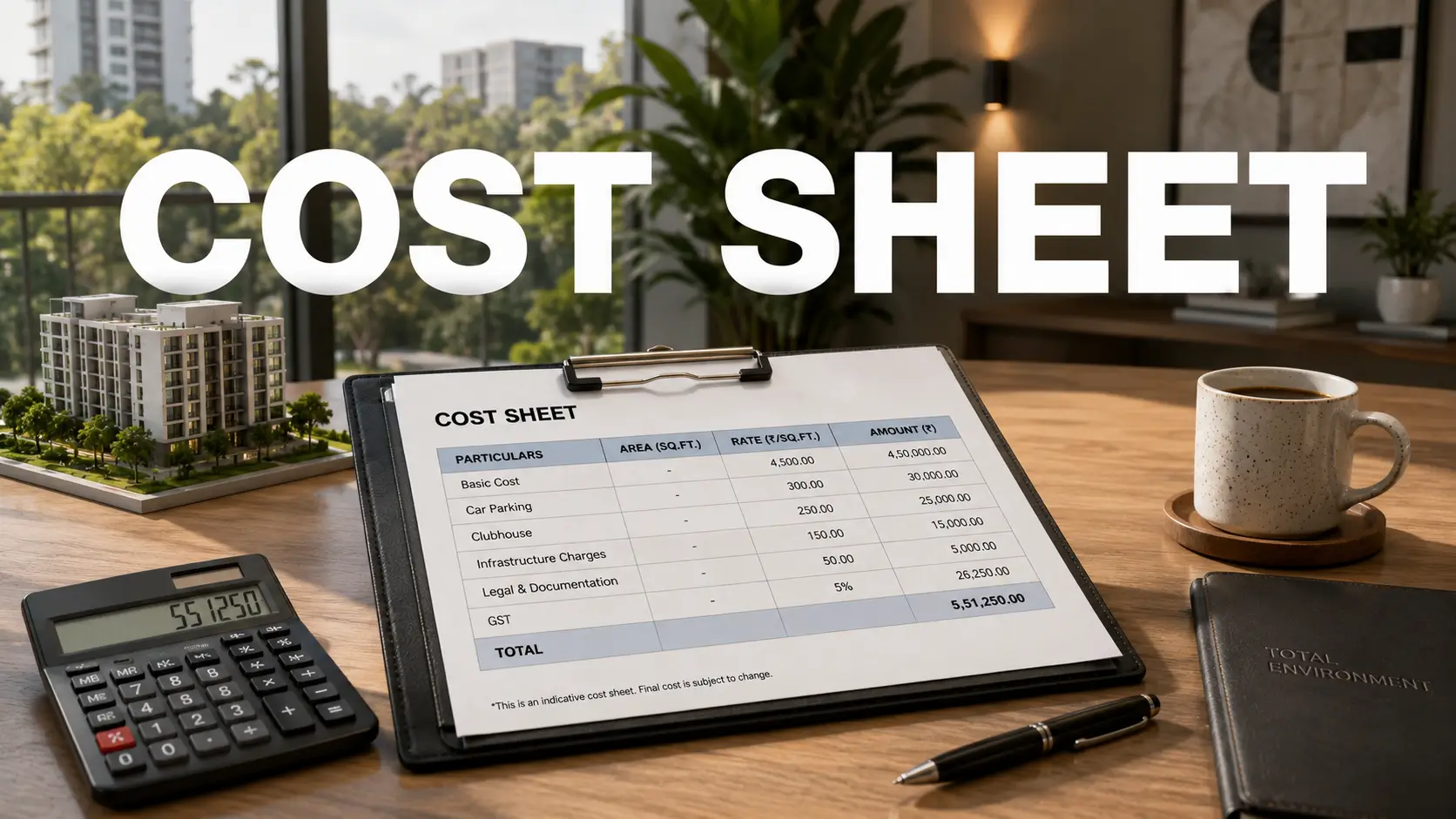
Understand the Embassy Eden cost sheet with a detailed price breakdown, payment schedule, statutory charges and key costs that shape the final villa purchase value.
Ask for a price and you get a number. Request the Embassy Eden cost sheet 2026 and you get the arithmetic behind it, which is the document that decides what you actually pay. The headline is Rs 25 crore onwards for a 5 BHK villa of 7,000-9,000 sft. What separates that headline from the figure on your final statement is where most buyers get surprised, and it is entirely avoidable.
What a Cost Sheet Is For
A cost sheet exists to unbundle a single number into the components a buyer can question. At this ticket the components are large enough that a percentage point matters in absolute terms. Read line by line and you can see which charges attach to the villa, which attach to the community, and which attach to the transaction itself. Those three categories behave differently, and conflating them is how a Rs 25 crore villa quietly becomes something else.
The Embassy Eden Price Breakdown, Line by Line
Basic sale price comes first. That is the villa and its plot before anything else attaches, and it is the figure most people mean when they say price. Plot preference charges follow where they apply, because a corner plot on the spine and a cluster interior plot of the same built-up area are not the same asset. Clubhouse and infrastructure charges come next, covering the ~1,568 sq m amenity block, the internal road network of roughly 27,439 sq m, and the services that run underneath it.
Statutory items sit outside the villa entirely. GST applies to the transaction. Stamp duty and registration attach at the point of conveyance. Deposits for power and water connections follow the sanctioned load, and BESCOM has cleared 1,846 KVA across the community. None of these are negotiable, and none of them appear in a headline price anywhere in the market.
Why the Embassy Eden 5 BHK Villa Price Is Not One Number
Ninety-five villas sit across roughly 30 acres at about three homes an acre. Plot dimensions shift by position rather than repeating one standard rectangle, and two typologies run through the layout - 58 homes of Type A and 37 of Type B. A quoted average across that spread would mislead you on both ends. Any Embassy Eden 5 BHK villa price worth acting on names a plot number, and if the quote you are holding does not, that is the first question to ask.
How to Read the Sheet
Three habits help. Check that every charge is itemised rather than folded into a line marked 'other charges', because that bucket is where ambiguity lives. Confirm which figures are fixed and which are estimates subject to actuals at handover, particularly deposits. And map the payment schedule against the construction programme rather than against a calendar - work started on 31 January 2026 with completion proposed for 31 December 2031, and a construction-linked plan should track the building, not the months.
The Protection Behind the Numbers
Section 4 of the Real Estate (Regulation and Development) Act, 2016 requires seventy percent of amounts realised to sit in a separate escrow account, drawn only against construction and land cost. Registration number PRM/KA/RERA/1251/472/PR/311225/008368 runs to 31 December 2031, which is the same date as proposed completion rather than earlier. That alignment matters: a registration expiring before handover leaves a buyer without a regulator to appeal to.
Getting the Real Number
There is no public price list for this scheme, and any page presenting one has invented it. Our team sends the sheet with every line itemised against the specific plot you are considering, alongside the payment plan mapped to the construction programme. Ask for the full figure rather than the headline. The gap between them is the part worth knowing before you commit, not after.
Comparing Cost Sheets Across Projects
Sheets are only comparable once you normalise them, and developers do not present them the same way. Put two side by side and check three things. Does each one separate the villa charge from the community charge from the statutory charge, or does it blend them into a total that flatters whichever project has the lowest headline? Are deposits shown as estimates subject to actuals, or as fixed figures that will quietly move at handover? And does the sheet quote against a named plot, or against an average that no buyer will ever actually pay?
The third question is the one that separates a serious quote from a marketing artefact. With plot dimensions varying across the layout and two typologies in play, an average is a fiction sitting between two real numbers. Ask for the plot number on the sheet. If it is not there, the quote has not been prepared for you - it has been prepared for anyone who asks, which is a different exercise entirely.
What Changes Between Now and Handover
Some lines are fixed at booking and some are not, and knowing which is which prevents an unpleasant conversation in 2031. The basic sale price fixes at agreement. Statutory rates - GST, stamp duty, registration - follow whatever the law says on the day the transaction completes, which on a five-year programme is a genuine variable rather than a technicality. Deposits against power and water connections settle against actuals. Ask our team to mark each line as fixed or floating before you sign, and keep that annotated copy.
Related Articles

Bangalore, GCC Capital: What It Means for Property Investors
Bangalore's GCC expansion is boosting North Bengaluru through leadership hiring, airport connectivity and sustained housing demand, making Bettahalasuru attractive for long-term villa investment.

Bangalore Smart City Initiatives & Their Real Estate Impact
Bangalore's smart city impact is driven by completed infrastructure, not announcements. North Bengaluru benefits from the airport, metro construction and road connectivity.

The Airport Economy: How KIA Is Reshaping North Bangalore
Bangalore Airport is driving North Bengaluru's growth through jobs, infrastructure and housing demand. Bettahalasuru benefits from this expanding airport economy, making it a strategic residential location.

How Bangalore's IT Boom Keeps Driving Real Estate Demand
Bangalore's IT boom continues to shape North Bengaluru through employment, airport-led growth and diversified industries, strengthening long-term housing demand around Bettahalasuru.